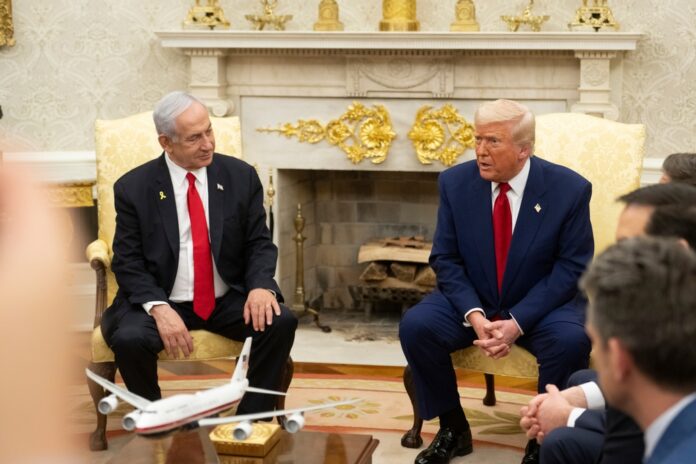
Reports of President Trump berating Prime Minister Netanyahu over potential Beirut strikes raise fresh alarms about secret decisions steering America toward wider war without public oversight.
Story Snapshot
- Multiple outlets report a heated Trump-Netanyahu call over Israel’s Lebanon operations, with coarse language and warnings about escalation [9].
- Trump publicly claimed he pressed Netanyahu to avoid a major Beirut operation and touted a halt in shooting, though fire reportedly continued soon after [1].
- Iran reportedly paused indirect talks with the United States as Israel-Lebanon fighting intensified, tying battlefield moves to diplomacy risk [13].
- Analysts say the episode fits a recurring pattern: private pressure, public reassurance, and unclear documentation that leaves citizens in the dark [6].
What Happened In The Reported Call
ABC News reported that President Donald Trump cursed at Israeli Prime Minister Benjamin Netanyahu during a roughly 15-minute phone call about potential escalation in Lebanon, highlighting White House concern that strikes near Beirut could widen the conflict [9]. Parallel broadcast summaries described Trump warning about consequences of a major Beirut operation and claiming that he pushed for restraint, even as Israeli officials signaled continued action if attacked [1]. The White House had not released a transcript at the time of those reports, leaving details dependent on sourced accounts [9].
Broadcast coverage summarized Trump’s claim that he asked Netanyahu not to launch a major military operation in Beirut and later framed the result as a pullback or pause, with hopes that calm would hold [1]. Subsequent reporting, however, noted that projectiles from Lebanon were reported after those statements, complicating any assertion that the call produced a decisive or lasting halt [1]. This tension between claimed restraint and continued fire underscores how fast-moving battlefield conditions can outpace diplomatic messaging [1].
Why The Stakes Extend Beyond Israel And Lebanon
Independent reporting indicated that Iran suspended indirect talks with the United States as Israeli strikes in Lebanon continued, linking frontline decisions to broader regional diplomacy and sanctions negotiations [13]. Analysts emphasize that private pressure between Washington and Jerusalem routinely intersects with efforts to deter Iran and contain proxy violence, meaning a single misread or misfire could ripple through oil markets, shipping lanes, and United States force posture [6]. This coupling of battlefield tempo and diplomacy raises real costs when documentation is thin and accountability uncertain [13].
Think tank analysis of United States–Israel relations during the Trump era describes a pattern where American presidents alternately signal support and apply pressure as crises flare, while Israeli leaders balance deterrence messaging at home with alliance management abroad [6]. That dynamic can produce split-screen narratives: leaders claim credit for restraint to reassure global markets, while militaries maintain options to respond to fire across the border [6]. The result is predictable confusion for citizens trying to understand who is driving decisions and to what end [6].
What We Know, What We Do Not, And Why It Matters For Americans
Confirmed elements include sourced accounts of a profane, tense call; Trump’s public assertion that he pressed Netanyahu to avoid a Beirut strike; and continued exchanges of fire after those claims [9][1]. Missing elements include an official transcript, a detailed readout from either government, or on-record confirmation from named participants about operational changes following the call [9]. Without those, voters cannot verify whether presidential pressure truly altered Israeli targeting or merely reframed events already in motion [1][9].
The Pro-Israel narrative says Hezbollah has fired thousands of rockets at Israel since March, killed 26 IDF soldiers and kept northern Israeli communities under constant fire, yet Trump blasts Netanyahu for responding. The leaked call details handed Iran and Hezbollah a…
— Verity (@improvethenews) June 3, 2026
Americans across the spectrum see a familiar problem: high-stakes foreign policy decisions shaped through private conversations, anonymous sourcing, and selective public claims. Conservatives worry about open-ended commitments and the risk of being dragged into another conflict; liberals worry about diplomacy being undercut by force-first instincts; both worry about elites deciding war and peace without transparency. This episode validates those concerns by showing how quickly narratives harden before documents appear—and how accountability fades in the fog of secrecy [6][9].
Sources:
[1] Web – WATCH: Trump Confirms Reports that He Went Off on Netanyahu – “I Was a …
[6] Web – Trump is furious with Netanyahu because Israel is still in …
[9] YouTube – Trump Tries to Secure Lebanon Ceasefire as Netanyahu …
[13] YouTube – IRAN WAR LIVE | Trump Blasts “F***ing Crazy” Netanyahu Over …