
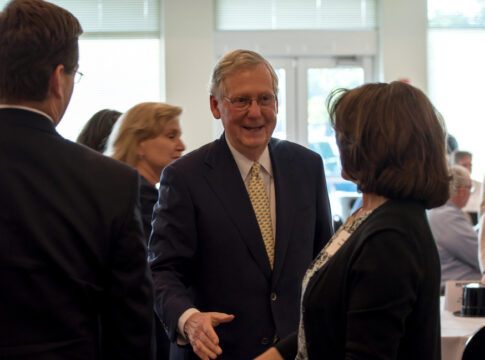
A single photo of Mitch McConnell holding a Sunday newspaper was meant to calm the country, but instead it sparked a wider debate over how much evidence the public now expects before believing official claims.
Story Snapshot
- Digital forensics experts say McConnell’s hospital photo is a genuine, recent image, not AI-generated or reused.
- The Washington Post sports section in his lap matches the July 12, 2026 print edition and the photo’s metadata.
- Critics still question why an elderly senator’s health is being proven with one staged image instead of open communication.
- The fight over this photo shows how deepfake fears and government secrecy are combining to erode public trust.
What The McConnell Photo Actually Shows And Proves
Senator Mitch McConnell’s office released a photo on July 12 showing the 84-year-old Republican in a rehabilitation facility with his wife, Elaine Chao, and a copy of The Washington Post sports section in his lap. The paper clearly displays the July 12, 2026 date, and Washington Post staff confirmed it matches that day’s print edition featuring Nationals draft pick Chris Hacopian. The Post also reviewed the original file’s metadata and found it lined up with a Sunday capture, backing the claim that the image is recent.
Outside experts did not simply “eyeball” the photo. Digital forensics specialists used lab tools to examine the pixels and look for signs of generative artificial intelligence or editing. Drexel University professor Matthew Stamm and his team reported no evidence of AI generation in the image. University of California at Berkeley professor Hany Farid ran analytical models on lighting, face geometry, and the newspaper and likewise found “absolutely no evidence” of AI fabrication or manipulation. Major fact-checkers, including PolitiFact, rated claims that the photo was AI or from 2023 as false.
Some Critics Remain Unconvinced
Even with this technical backing, many people online were not convinced. Social media users claimed the image was an old hospital photo or AI-generated, while a Republican senator, Ron Johnson, said he “heard” it was an older picture but admitted he had not spoken to McConnell himself. Commentators on both right-leaning and left-leaning platforms argued that one staged photo is not real “proof of life,” especially after weeks of silence from McConnell and no direct video statement from him. Their doubts reflect frustration with a political class seen as hiding the truth until it becomes impossible.
Body language and forensic psychology commentary focused less on whether the photo is fake and more on what it reveals about McConnell’s condition. Some commentators pointed to McConnell’s appearance in the photo—including his hospital bed and visible bruising—as raising additional questions about his recovery, though a single image cannot establish someone’s overall medical condition. Critics highlighted a medical statement that downplayed his injuries yet admitted brief unconsciousness and a long rehab stay, arguing that this mixed messaging feels like spin instead of straight talk. For many Americans, that gap between words and reality is now the norm in Washington.
Deepfakes, Fake Close-Ups, And A Broken Trust Environment
The McConnell photo controversy did not happen in a vacuum. Around the same time, a separate, disturbing image showing him covered in tubes in a hospital bed went viral and was later proved to be AI-generated using tools from Google and OpenAI that detected invisible watermarks. Fact-checkers also traced a widely shared “gibberish” close-up of the newspaper text back to an AI hallucination, not to the original photo released by his office. The mix of real and fake images made it harder for ordinary people to know what to believe, especially when they already assume the government and media play games with the truth.
Researchers warn that this “liar’s dividend” is a growing problem: as deepfakes spread, liars can deny real photos as fake, and skeptics can treat fake images as proof. Americans have lived through years of manipulated or staged political images, from carefully choreographed hospital photo ops to official pictures that are later exposed as edited. Studies show people care deeply about whether politicians are honest and consistent, and they quickly see “photo theater” as a sign of inauthenticity. In that context, even a genuine image like McConnell’s can feel more like propaganda than transparency.
What This Moment Says About Power And Accountability
The deeper issue is not whether this single photo is real; most serious analysts now agree it is an authentic, recent shot. The trouble is that Americans on both the left and right see a pattern: elderly leaders stay in powerful jobs while their staff control information, doctors’ letters are released without full details, and key decisions happen behind closed doors. The McConnell image proves he is alive and able to pose, but it tells voters almost nothing about his actual capacity to serve or who is making choices in his name. That gap feeds concerns that important decisions may be made with limited public visibility.
#new Sen. Mitch McConnell announces he will be absent from the Senate floor today as it returns to session, so he can continue to 'recover', but the extended absence and the changing details surrounding his hospitalization are raising questions.#DC
His office is now saying that… pic.twitter.com/Rh0tFKnuEg
— Christina Aguayo (@ChristinaNewstv) July 14, 2026
The fight over one hospital photo shows how broken our verification systems have become. Instead of simple, direct updates—a short video, independent medical confirmation, or open press access—Americans are asked to trust pixel scans and anonymous statements from staffers. Legal scholars note that in court, challenges to deepfakes must rely on hard details like metadata, provenance, and missing originals, not just “it could be fake.” Citizens deserve the same standard: clear evidence and full context.
Sources:
feedpress.me, wdsu.com, leadstories.com, facebook.com, youtube.com, snopes.com, timesofindia.indiatimes.com, deanblundell.substack.com, politifact.com, techcrunch.com, btimesonline.com, newsbreak.com, nationalgeographic.com, tandfonline.com, misinforeview.hks.harvard.edu
2 comments:
1. The sources listed above are mostly biased and left leaning, so anything gained from them is not regarded as reliable.
2. The fact that he is not in the senate chambers is not a bad thing. Based on his past performance, America is much better served by his being absent.